The Question I Always Get
When I give talks on the n-color homologies, I am often asked whether the underlying topological quantum field theory (TQFT) is based on 


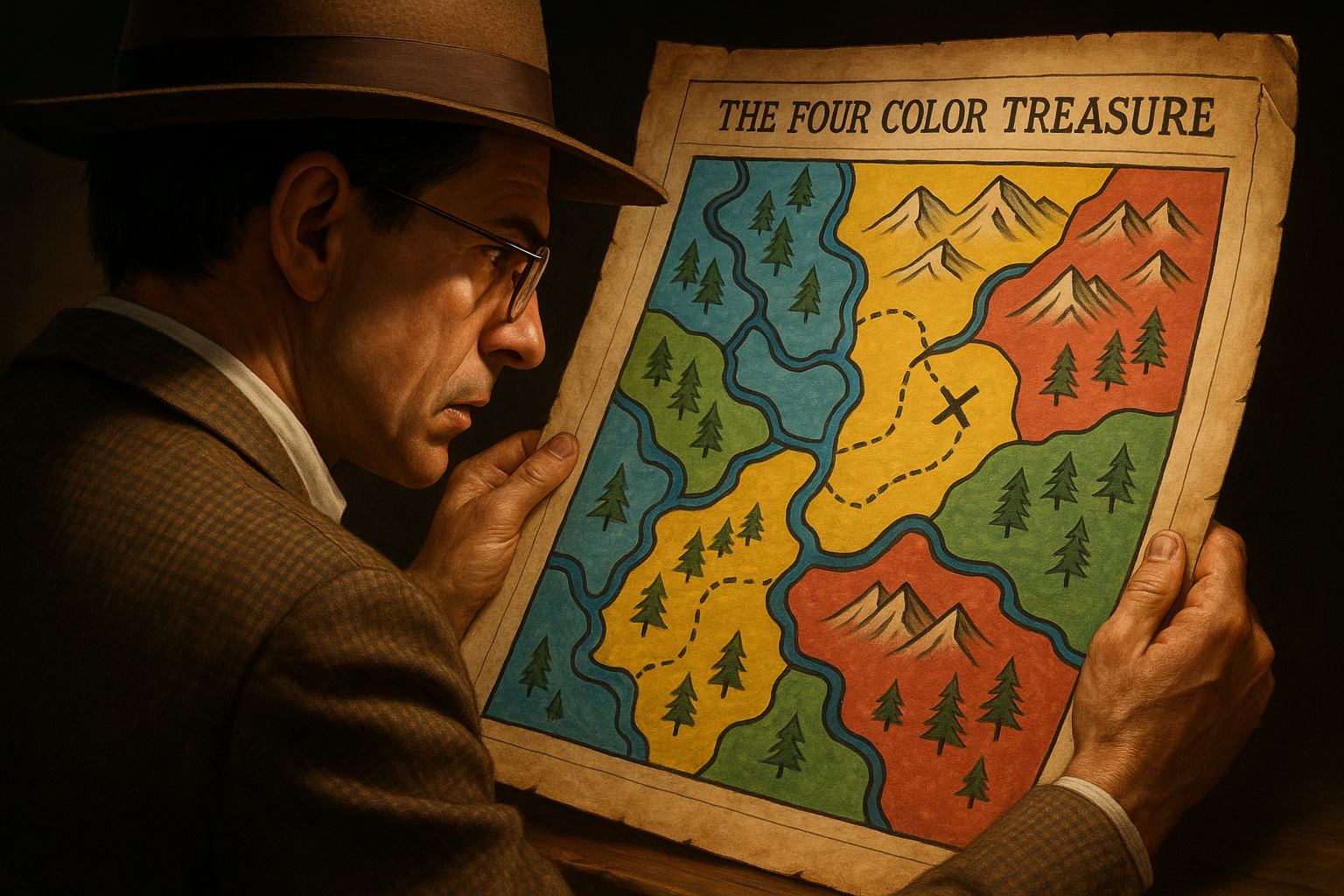
When I give talks on the n-color homologies, I am often asked whether the underlying topological quantum field theory (TQFT) is based on
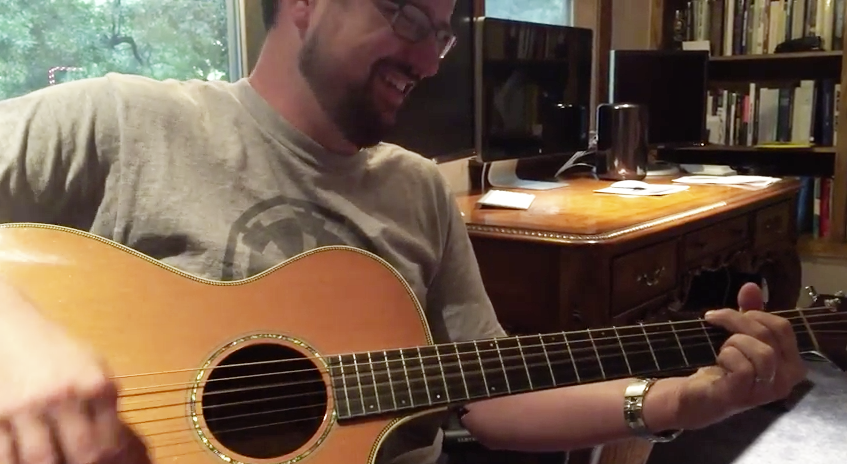
Mathematicians have many talents! In this episode, mathematician Ben McCarty plays and sings the song, “Swing that Hammer.” Ben is a professor of mathematics at the University of Memphis. He is my coauthor on a new paper that proves the Birkhoff diamond is reducible using topological quantum field theory, which is the first step in all currently correct proofs of the four color theorem. We show this can be done using state systems in Quantum Mechanics — the first proof of its kind.
CHANNEL: Geometry and Topology Today
© 2025 Scott Baldridge and David Shea Vela-Vick
Intended Audience: Teachers, prospective teachers, and parents (public, private, homeschool).
In this video, Autumn and I describe the number Pi and say a little bit about the history of one of the most famous numbers. Happy Pi day!
Continue readingAre you going to the NCTM 2018 conference next week in Washington, DC? Do you want to learn about the thinking behind the Eureka Math/EngageNY curriculum from the lead writer and lead mathematician? Then put the following talk on your schedule:
Intended Audience: Everyone: Students, teachers, prospective teachers, and parents.
Ramanujan’s work has had a truly transformative effect on modern mathematics, and continues to do so as we understand further lines from his letters and notebooks. In this YouTube video, Ken Ono presents some of the studies of Ramanujan that are most accessible to the general public and talks about how Ramanujan’s findings fundamentally changed modern mathematics. Continue reading
Intended Audience: Teachers, prospective teachers, and parents (public, private, homeschool).
In this video, 7-year-old Autumn explains the addition algorithm (column addition) using place value tables. We address the story of a frustrated dad who wrote a “place value table” on a check and how his frustration is not with place value tables. We discuss good ways to use place value tables to teach the addition algorithm and when place value tables have overstayed their purpose. Enjoy!
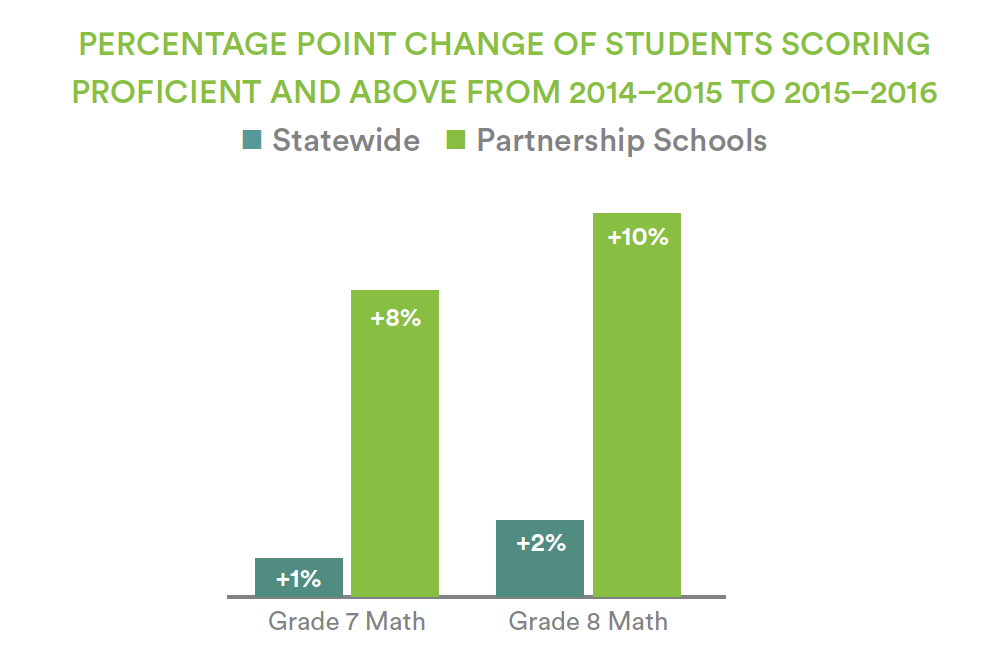
Good news just keeps rolling in: Students in Partnership Schools who started using Eureka Math last year showed an 8% improvement in seventh grade and a 10% improvement in eighth grade on the end-of-year New York state math test over the previous year students:
 Continue reading
 Intended Audience: Mathematicians, physicists, graduate students, and advanced undergraduates.
In this video, mathematician Tim Nguyen gives an informative overview of the perturbative approach to path integrals and explains his work on the features of path integral manipulations.
Continue reading
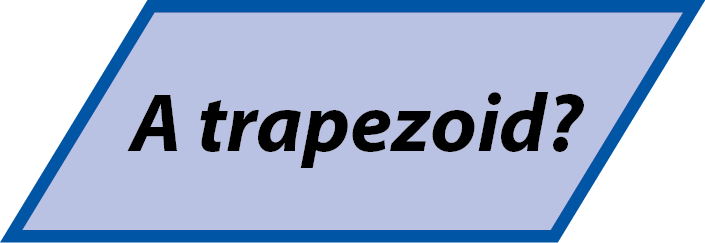
Here is an excellent question from a user of Eureka Math:
I was reviewing the Grade 4 Module 4 lessons and videos and saw the definition of a trapezoid as a quadrilateral with at least one pair of parallel sides. I know this is correct, but my question is, how useful is this vs. a previous common understanding (or misunderstanding) that many of us had, that a trapezoid is a quadrilateral with exactly one pair of parallel sides? I was just thinking about this today and couldn’t think of how being able to classify all parallelograms also as trapezoids is useful, whereas it seemed very clean and clear to identify and recognize quads with only one pair of parallel sides as trapezoids and to be able to say “this is what a trapezoid is” rather than “this is one type of trapezoid”. Any thoughts on this?
 One issue that universities all over the United States face today is how their beginning math courses have become student obstacles to earning a degree, and in particular, a degree in science, technology, engineering, and mathematics (STEM). There are a number of reasons for this barrier, some of which started long before students entered college. However, much can be done at the collegiate level to tear down this wall without giving up high quality mathematics instruction demanded by many degree disciplines.
Last week I had an opportunity to visit a university that is working hard to improve its beginning math courses: Michigan State University. Continue reading
On the big list of things to do, making a biography of myself is at the very bottom of the priority list. It’s one of those things you eventually get roped into doing for other reasons. I’ve finally created a short bio that you find on my “about page” above or by clicking here. Enjoy?
While you’re at it, subscribe to my YouTube channel because it is the cool thing to do.
CHANNEL: That’s News to Me
© 2016 Scott Baldridge
Intended Audience: Teachers, prospective teachers, and parents (public, private, homeschool).
In this video, 7-year-old Autumn tells whether a number from 1-100 is the product of two 1-digit numbers. This is an important step along the way of using the multiplication table to learn the division facts.
Intended Audience: Everyone, and especially teachers who want to show to their students a mathematician explaining the motivation behind their own research.
In this episode we meet Pallavi Dani, a mathematician here at Louisiana State University, who talks to us about using geometry to study problems in algebra and vice versa.
Intended Audience: Teachers, prospective teachers, and parents (public, private, homeschool).
In this video, 7-year-old Autumn realizes that she does know the complete multiplication table! Here’s the story:
Intended Audience: Teachers, prospective teachers, and parents (public, private, homeschool).
In this video, 7-year-old Autumn uses skip counting to find 

Tom Rademacher wrote a nice piece about my stepfather’s teaching:
Fred Reusch: Teacher, Tutor, ‘Coolest Man Ever’
You may remember my dad from one of my earlier posts, What it is like to be the son of Captain Derivative, and his picture:

Here are a couple of my thoughts about Rademacher’s article and my dad that will hopefully add a little “lagniappe” to the piece and Fred’s teaching:
Intended Audience: Research mathematicians, graduate students, and advanced undergraduates.
In this episode we see a research talk presented by Clayton Shonkwiler, a mathematician at Colorado State University, who is speaking to us about applications of geometry and topology to random walks/polygons and polymer physics.
My 7-year-old daughter, Autumn, and me were discussing how an atom is made up of mostly empty space with a small nucleus of protons and neutrons in the “center” and electrons swarming about it. During the discussion, she asked an insightful question,
“Can an atom have two cores (two nuclei)?”
Columnist Jay Mathews writes in a new Washington Post article, Many parents hated Common Core math at first, before figuring it out,
Dear Mr. Mathews: Thank you for sharing these stories. Continue reading
Intended Audience: Mathematicians, graduate students and ambitious high school students.
We continue our interview with Clayton Shonkwiler on applications of geometry and topology to random walks/polygons and polymer science, but now at a graduate student level. To see the earlier interview with Clayton geared at a high-school level, go to: Mathematician Clayton Shonkwiler talks about Polymer Science.
Intended Audience: Teachers, prospective teachers, and parents (public, private, homeschool).
In this video, 7 year old Autumn leads an audience of about 100 teachers in doing arithmetic problems. Watch her explain how she uses different methods to solve problems other than the “standard column math” method (algorithms), and allow me to explain why it is important to build curricula that encourage all of these methods.
Intended Audience: Teachers, prospective teachers, and parents (public, private, homeschool).
Recently Autumn asked, “In the twelve days of Christmas, which of the presents do you get the most?” This is the type of question you hope your child asks you, because it can lead everyone in the family on a great adventure where math just “happens” in the course of thinking through the answer.
Intended Audience: Teachers, prospective teachers, and parents (public, private, homeschool).
Autumn is now 7 years old! Thank you to everyone out there who has been watching her grow up. We have many more great videos planned for this year, so please like us on Facebook (www.fb.com/ScottJBaldridge) or follow us @ScottBaldridge, or follow this blog for updates.
Autumn asked, “Why don’t you wear a girl superhero T-shirt for our videos, dad?” And I said, “Why not? Absolutely!” We started searching for a woman superhero T-shirt for men but ran into trouble: There are a lot of women superhero T-shirts for women, but very few for men that are perfect for our video series. So we need your help!
If you know of an excellent woman superhero T-shirt for men, please share it with us in the comment section below. If you include your name (you don’t have to), we will thank you in the video when I wear your T-shirt!
CHANNEL: Growing up with Eureka
© 2015 Autumn Baldridge and Scott Baldridge
Intended Audience: Everyone, and especially teachers who want to show to their students a mathematician explaining the motivation behind their own research.
In this episode we meet Clayton Shonkwiler, a mathematician from Colorado State University, who talks to us about applications of geometry and topology to the study of random polygons and polymer science. Continue reading
Intended Audience: Teachers, prospective teachers, and parents (public, private, homeschool).
In this video, 6-year-old Autumn explains that a variable is a slot that you can put a number into. The slot is usually represented on paper as a letter (such as x) or a mark (such as ___). Here’s the definition of a variable symbol: Continue reading
The SciState Studio is finished and we’re all ready for production! In this video, we get a behind the scenes look at some of the finer details of our studio construction. As we embarked on this adventure, one of the first things we learned was that high-quality audio is an essential component of any successful video series. With this in mind, we have outfitted our studio with acoustic insulation panels and installed various other echo reducing components throughout. We also constructed an awesome plexiglass “light board,” which is similar to a traditional whiteboard but doesn’t require one’s back to face the camera. We’re really proud of everything we’ve produced and hope you agree!

We should point out that it takes a real expert (thank you Justin Reusch!) to set up the lighting for the video stage. You can see how that came out by watching our “Testing out the Green Screen” video. As a point of comparison, note the terrible sound in the “Testing out the Green Screen” video—that is what the studio sounded like before we built the acoustic insulation panels.
As always, comments are welcome below.
CHANNEL: Geometry and Topology Today
© 2015 Scott Baldridge and David Shea Vela-Vick
Supported by NSF CAREER grant DMS-0748636 and NSF grant DMS-1249708

Above is a picture of my stepdad, Captain Derivative, doing integration exercises for yet another day in the vector field against his arc enemy, the pathological and degenerate Prime Matrix.
Some people have asked me, “What is it like being the son of a differential operator who can wield power series with such ease?” Well, when I was young and still very near my initial value, I used to oscillate rapidly between believing whether his exponential powers were real or imaginary–often shifting my phase over time with some frequency. But then he removed a discontinuity from a complex surface right before my very eyes, and I saw the proof of his limitless analysis: I converged upon the realization that my own scientific skepticism had been irrational. From that moment on (t=5), I would often help him from his secret power base by relaying coordinates of tangents he could approach in the Cartesian plane so he could do battle against those divergent improper integrals.
Go Captain Derivative, we are with you (or at least, within an epsilon ball of you). May the functions you differentiate always be smooth!
(My stepfather, Fred Reusch, is the calculus teacher at my old high school in Rockford, Michigan. Today was “Super-hero Day” at the school, and he came dressed as “Captain Derivative.” I think he would wear this outfit to school everyday if he could! 🙂 )
CHANNEL: That’s News To Me
© 2015 Scott Baldridge
Intended Audience: Research mathematicians, professors of mathematics, graduate students in mathematics, and advanced undergraduate students in mathematics.
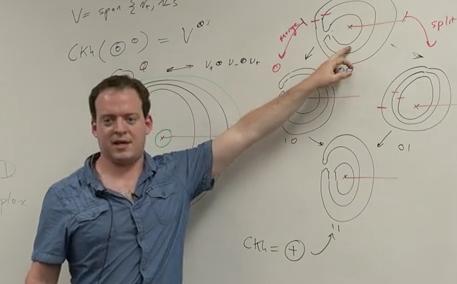
In this 1 hour episode, we see a presentation by Adam Saltz, a mathematician and graduate student at Boston College, on a new invariant of transverse knots in links coming from Khovanov homology.
In the talk, Adam discusses some of the details contained in his paper with Diana Hubbard, An annular refinement of the transverse element in Khovanov homology. Here is the abstract to their paper:
We construct a braid conjugacy class invariant κ by refining Plamenevskaya’s transverse element ψ in Khovanov homology via the annular grading. While κ is not an invariant of transverse links, it distinguishes some braids whose closures share the same classical invariants but are not transversely isotopic. Using κ we construct an obstruction to negative destabilization (stronger than ψ) and a solution to the word problem in braid groups. Also, κ is a lower bound on the length of the spectral sequence from annular Khovanov homology to Khovanov homology, and we obtain concrete examples in which this spectral sequence does not collapse immediately. In addition, we study these constructions in reduced Khovanov homology and illustrate that the two reduced versions are fundamentally different with respect to the annular filtration.
This video and paper are aimed at mathematicians, graduate students and undergraduates with lots of experience in topology. However, high school students who think they are potential math geniuses may still enjoy looking at it to see what advanced theorems and proofs look like.
As always, comments are welcome!
CHANNEL: Geometry and Topology Today
© 2015 Scott Baldridge and David Shea Vela-Vick
Supported by NSF CAREER grant DMS-0748636 and NSF grant DMS-1249708


 Scott Baldridge
Back to Blogging: My Life in Math and Education
I stopped blogging about six years ago for some very good reasons. The main reason is that I jumped back into doing math research professionally. Maybe not surprisingly, that consumes a ton of time. (Generating new theorems with proofs, despite the old quote about mathematicians and coffee, is not simply about turning on a machine.) Outside of work, I also wanted to spend more time with my family while raising Autumn. I know many of you want to know what’s happened in her life since her “Growing up with Eureka” days. We might do some new videos together to show you, but that all depends on her decisions.
Life is good. I work hard at playing with math. I think deeply about philosophy (always have). I work on my cars to keep me dirty and grounded. I taught some new non-math courses and met some wonderful young people in doing so. Better still, I always have six to seven utterly brilliant math research graduate students hanging around me at the office.
Living the quiet professor life has got to be one of the greatest gigs in the world. That is, if you can get it. It’s basically a teaching job on many different levels (K-12, undergraduate, graduate, postdoc, assistant professors, etc.), which means you are always connecting to each new generation. If you like your students, and I do, then your job is to guide them. You are helping them to become mature adults who can tackle the next set of difficult problems for society. The research part of a professor’s life is much harder, I am not going to lie. It is full of “publish or perish” type thinking and reputation management. And getting to the coveted “tenured professor” position is an exercise in “running the gauntlet,” even for the world’s brightest. But if you make it, it is definitely worth it. Some of my new blog posts will help young people get into math research. They will also guide them in navigating graduate school and postdocs. There are definite ways to look at the world that will help you succeed if you seek this path.
I am still and have always been engaged in mathematics education at the elementary, middle, and high school levels, including education policy and teacher preparation. I teach classes for prospective elementary, middle, and high school math teachers from time-to-time using my college textbooks. I work with a bunch of amazing educators at the Cain Center for STEM Literacy. They are finding new solutions to difficult problems around educating our youth in STEM. I can’t say enough good things about them and their activities. And when I’m not doing all of that, I am getting my hands dirty reviewing problems for our nation’s report card (NAEP) on the mathematics standing committee. That is another group of passionate professors, educators, and teachers. They are enthusiastic about their work and guarantee the problems are appropriate, rigorous, and correct. Many organizations work together to create the NAEP exam. Collectively, they exemplify one of our government’s shining jewels. They are real professionals. All this means I still have plenty to write about on my blog with regards to education.
I haven’t even talked about my math research! I need new graduate students to investigate all the interesting research questions I generate each day. Math isn’t necessarily fun, but it is immensely rewarding. So I’ll try to talk more about that too on my blog.
Like I said, life is good.